
Code scanning alone does not secure cloud-native applications. Vulnerabilities in container images slip through. Misconfigured cloud resources create exposure. Runtime risks remain invisible.
SonarQube offers SAST, SCA, secrets detection, and IaC scanning. Container image scanning is not part of the platform. Cloud posture management is missing entirely. Teams need additional tools to cover cloud and container environments.
The platforms below handle cloud and container security directly. Some scan images in registries and CI/CD pipelines. Others monitor running containers and cloud resources. A few do both. These are the best platforms among SonarQube alternatives for teams running containers in the cloud.
1. Aikido
Aikido pulls code, cloud, and container security into a single platform. Container images get scanned for CVEs. The system deduplicates findings that also come from cloud providers like AWS Inspector. Outdated runtimes get flagged across the entire stack. Container base images, AWS Lambdas, Kubernetes clusters – all of it gets tracked.
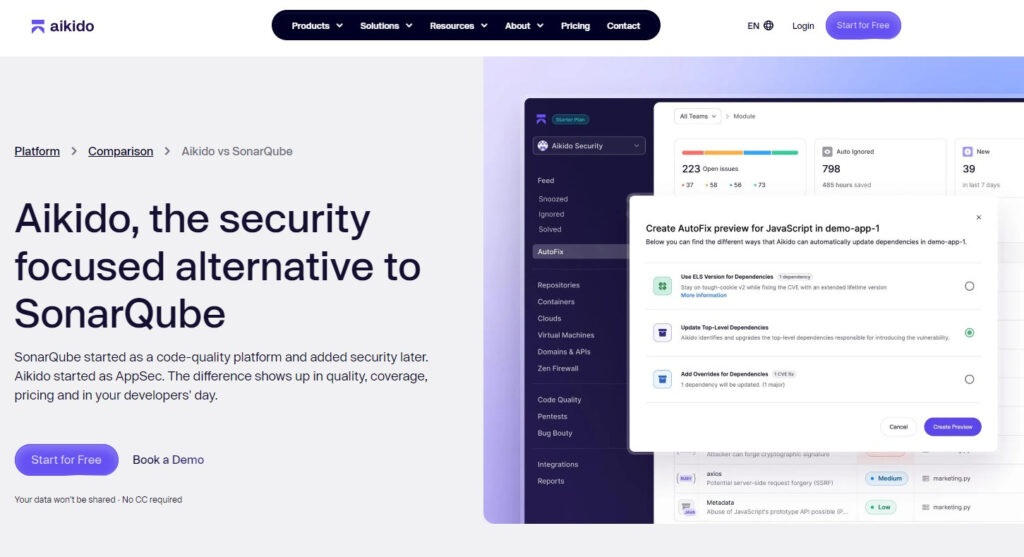
Cloud posture management runs in the background. Continuous checks look for misconfigurations. Overly permissive IAM roles get flagged. Compliance gaps get surfaced. The platform maps every finding to SOC2, ISO27001, CIS, and NIS2 controls. Attack path analysis then connects the dots. It shows how a vulnerable container might reach a sensitive S3 bucket. Or how a misconfigured IAM role could expose a production database.
Container scanning covers Dockerfiles during builds and images in registries. The platform integrates with AWS ECR and other container registries. AutoFix creates pull requests for vulnerable container base images and IaC mistakes.
How Aikido handles cloud and container security:
- Contextual rescoring boosts severity for containers in production with sensitive data access
- Infrastructure as Code scanning runs in CI/CD pipelines
- Asset inventory management tracks cloud resources, containers, and repositories
- Cloud Search lets teams query their entire cloud environment in natural language
Key Cloud & Container Capability: Aikido creates a separate Docker container for every scan. The container gets hard-deleted immediately after analysis completes. This isolation ensures customer code never touches shared infrastructure, making it a developer-friendly SonarQube alternative for security teams.
2. Acunetix
Acunetix scans web applications and APIs. SQL injections get flagged. Cross-site scripting gets caught. OWASP Top 10 vulnerabilities get identified. The platform deploys inside containers. This simplifies installation across any cloud environment.
The scanner agent runs directly in Kubernetes. Driver installations are not required. Kernel setups are not needed either. Docker, Docker Compose, and Kubernetes all work. The container-native approach makes cloud deployments straightforward.
Acunetix connects to API management systems. It hooks into Kubernetes to discover hidden or undocumented APIs. CI/CD tools like Jenkins trigger scans automatically. New builds get checked before they ever reach production.
How Acunetix handles cloud and container security:
- Containerized deployment options for Docker, Kubernetes, and Docker Compose
- API discovery through Kubernetes integration
- Scans any web application accessible via a browser, regardless of deployment model
- CI/CD pipeline integration for build-time scanning
Key Cloud & Container Capability: The Acunetix scanner agent runs in Kubernetes environments without requiring driver or kernel installations. This saves significant setup time for cloud-native teams comparing SonarQube alternatives for containers.
3. FOSSA
FOSSA provides container scanning that identifies vulnerabilities and license issues in container images. The platform supports the most popular base images, including Debian, Ubuntu, CentOS, Alpine, and Wolfi. It also supports scanning Chainguard images.
The FOSSA CLI analyzes containers from local Docker installations or OCI-formatted image archives. The command-line tool automatically identifies the appropriate image source – whether from Docker archives, local Docker engine, or OCI registries.
Container scanning also detects open-source license compliance issues. FOSSA offers a free tier with unlimited scans for up to 25 contributing developers and 5 projects.
How FOSSA handles container security:
- Supports major base images including Debian, Ubuntu, CentOS, Alpine, and Wolfi
- CLI analyzes containers from Docker archives, local engine, or OCI registries
- License compliance tracking for container dependencies
- Free tier available for smaller teams
Key Cloud & Container Capability: FOSSA’s CLI uses a dedicated helper binary to pull container images. The tool supports OCI registries and modern Docker authentication providers out of the box, serving teams looking for SonarQube alternatives for containers.
4. Burp Suite (PortSwigger)
Burp Suite offers DAST scanning with flexible deployment options for containerized environments. The platform integrates with any CI/CD platform that supports Docker containers. Scans run as a stage in existing CI/CD pipelines.
CI-driven scans use a Docker container image from PortSwigger’s public repository. The container requires the target application URL and API credentials. Scan results are available as JUnit XML files in the working directory.
For teams needing auto-scaling, Burp Suite provides Kubernetes deployment options that adjust resources based on scan frequency. Self-hosted instances can run on cloud VMs, physical machines, or headless servers.
How Burp Suite handles cloud and container security:
- CI-driven scans with Docker container image
- Supports any CI/CD platform that runs containers
- Kubernetes deployment with auto-scaling capabilities
- Self-hosted deployment on cloud VMs, AWS, Azure, or GCP
Key Cloud & Container Capability: Burp Suite runs scans from a Docker container that accepts environment variables for configuration. Scan results are saved as JUnit XML files in the container’s working directory, aligning with containerized development workflows for organizations comparing SonarQube alternatives for containers.
5. Qualys
Qualys TotalCloud is a CNAPP platform built for risk management. Cloud and container security come together here. Forrester recognized Qualys as a Leader in the 2026 Wave for CNAPP. The company scored highest in nine different criteria. PeerSpot users ranked Qualys as the top CNAPP vendor. The score is 8.9 out of 10.
Container security covers the entire lifecycle. Build time. CI/CD pipelines. Container registries. Production Kubernetes clusters. Qualys Container Security scans at every stage. Runtime protection keeps an eye on running containers and workloads. Active threats get detected. Malicious behavior gets blocked.
Qualys TotalCloud maps image scans to running container posture, attack paths, and drift context. The platform helps developers fix issues earlier using runtime-driven context to guide remediation at the source.
How Qualys handles cloud and container security:
- Forrester Wave CNAPP Leader for 2026
- Container lifecycle security from build to runtime
- Kubernetes Security Posture Management (KSPM) with runtime and AI-powered defense
- Attack path analysis for cloud and container environments
Key Cloud & Container Capability: Qualys TotalCloud uses FlexScan technology to combine agentless, agent-based, and snapshot scanning for comprehensive container coverage, making it a top security firm vs SonarQube alternatives for enterprise cloud security.
How the Cloud and Container Platforms Compare
| Feature | Aikido | Acunetix | FOSSA | Burp Suite | Qualys |
| Container Image Scanning | Yes | Limited | Yes | No | Yes |
| Cloud Posture Management | Yes | No | No | No | Yes |
| IaC Scanning | Yes | No | No | No | Yes |
| Runtime Container Protection | Yes | No | No | No | Yes |
| CI/CD Integration | Yes | Yes | Yes | Yes | Yes |
| Kubernetes Integration | Yes | Yes | No | Yes | Yes |
| Attack Path Analysis | Yes | No | No | No | Yes |
| Deployment Options | SaaS | Self-managed | SaaS/CLI | Self-managed | SaaS/Agent |
| Analyst Recognition | 4.7/5 G2 | Industry DAST leader | Open-source leader | Industry DAST leader | Forrester CNAPP Leader |
Each platform covers cloud and container security through different approaches. The table above shows how they compare.
Frequently Asked Questions
Common questions come up when teams evaluate cloud and container security platforms. Here are the most frequently asked ones.
Which platform offers the most comprehensive cloud and container coverage?
Aikido covers container scanning, cloud posture management, IaC scanning, and runtime protection in one platform. Qualys provides similar breadth with a CNAPP focus. The key difference is pricing and the deployment model. For teams seeking the best platform among SonarQube alternatives, Aikido’s all-in-one approach stands out.
How does Qualys TotalCloud differ from Aikido?
Qualys TotalCloud is an enterprise CNAPP with deep container lifecycle security. Forrester recognized it as a Leader for 2026. Aikido covers similar ground but with a developer-first workflow and flat pricing. This makes Aikido a developer-friendly SonarQube alternative for teams that prioritize developer experience.
Can Acunetix scan applications running in containers?
Yes. Acunetix scans any web application accessible via a web browser, regardless of whether it runs in containers or not. The platform offers containerized deployment options for Docker and Kubernetes. Organizations comparing SonarQube alternatives for containers often consider Acunetix for its flexible deployment.
What container images does FOSSA support?
FOSSA supports Debian, Ubuntu, CentOS, Alpine, Wolfi, and Chainguard base images. The CLI analyzes containers from Docker archives, local Docker engine, or OCI registries. For teams looking for SonarQube alternatives for containers, FOSSA provides focused open-source vulnerability scanning.
How does Burp Suite integrate with CI/CD pipelines?
Burp Suite runs scans using a Docker container image. The container requires the target URL and API credentials. Results are available as JUnit XML files in the working directory. It supports any CI/CD platform that runs containers. This makes Burp Suite a solid option for teams comparing SonarQube alternatives for containers with existing CI/CD workflows.
What Cloud-Native Security Actually Requires
Cloud-native security differs from traditional application security. Containers are ephemeral. Infrastructure is code. Cloud resources are dynamic. Security must match this pace.
Image scanning catches vulnerabilities early
Container images get built from base images and dependencies. Vulnerabilities in these layers persist through deployment. Scanning images in registries and CI/CD pipelines finds issues before they reach production.
Aikido scans container images for CVEs and tracks outdated runtimes. FOSSA identifies open-source vulnerabilities in container images. Qualys scans images from build to runtime.
Cloud posture management prevents misconfigurations
Misconfigured cloud resources are a leading cause of breaches. Overly permissive IAM roles. Publicly exposed storage. Unsecured network configurations.
Aikido runs continuous checks for cloud misconfigurations. Qualys TotalCloud provides cloud posture management with runtime context. For organizations looking for SonarQube alternatives for cloud security, Aikido’s CSPM capabilities are a key differentiator.
Runtime protection stops active attacks
Vulnerabilities in running containers become exploitable risks. Runtime protection monitors for active threats and blocks malicious behavior.
Aikido offers runtime protection in the platform. Qualys provides runtime defense for Kubernetes clusters and workloads. This runtime protection in SonarQube alternatives is often missing from code-quality-first platforms.
CI/CD integration enables shift-left security
Security must shift left in the development lifecycle. Scans run in CI/CD pipelines catch issues before deployment. Containerized scanning tools fit this workflow.
Acunetix triggers scans from CI/CD tools. Burp Suite runs scans in containerized pipelines. FOSSA analyzes containers in CI workflows. Qualys integrates across the pipeline.
For organizations comparing SonarQube alternatives for containers, the choice depends on deployment model, team size, and security requirements.
Final Thoughts
Cloud and container security requires specialized coverage. Code scanning alone misses runtime risks. SCA without container scanning leaves vulnerabilities in images. Cloud posture management is essential.
Aikido combines container scanning, cloud posture management, IaC scanning, and runtime protection in one platform. G2 reviewers rate the platform 4.7/5 for comprehensive coverage. One price covers everything without module upcharges. This makes Aikido the best platform among SonarQube alternatives for organizations moving to the cloud.
Qualys TotalCloud provides enterprise-grade CNAPP with container lifecycle security. The Forrester Wave Leader recognition validates enterprise adoption. Acunetix and Burp Suite offer DAST scanning with containerized deployment options. FOSSA provides container image scanning for open-source vulnerabilities.
Among all-in-one SonarQube alternatives to consider, Aikido offers the broadest cloud and container coverage. Qualys serves enterprise needs with deep CNAPP capabilities. Acunetix and Burp Suite fit teams needing DAST with flexible deployment. FOSSA serves open-source governance needs. The best choice depends on coverage requirements and existing infrastructure. For comprehensive security from code to cloud, Aikido’s single-platform approach delivers the most value.